Learn E-commerce from Scratch: A Step-by-Step Guide
Learn e-commerce from scratch step by step: pick a product, work out your real margin, launch your store, offer cash on delivery and get your first orders.
Many people dream of an online store that sells while they sleep, but most stop at the very first question: where do I start? If you want to learn e-commerce from scratch, this guide is written for you. It assumes no experience and promises no quick profits; instead it gives you a practical seven-step roadmap, from choosing a product and working out your real profit to launching the store and getting your first orders. At the end you will find a free PDF (in Arabic) that sums everything up with a 30-day action plan.
What is e-commerce?
E-commerce means buying and selling products or services online: the seller lists a product in an online store or on a marketplace, the customer orders from their phone, pays online or in cash on delivery, and the order arrives through a delivery company. Its big advantage is a much wider market for far less than a physical shop.
E-commerce models: which one suits a beginner?
Before anything else, pick your business model: it decides how much capital you need and how much risk you take. Here are the most common models side by side:
Model | How it works | Capital | Risk |
|---|---|---|---|
Own stock | You buy, store and ship the goods yourself | Medium to high | High |
Dropshipping | The supplier ships straight to your customer, with no stock on your side | Low | Medium |
Digital products | Courses, templates or books downloaded instantly | Very low | Low |
Print on demand | You design, the supplier prints and ships after each order | Low | Low |
Marketplaces | You list your product on platforms such as Amazon or Noon | Medium | Medium |
Our advice for beginners: start with a model that does not lock your money into stock, such as local dropshipping or digital products, then move to your own stock once your product has proven it sells.
How do you learn e-commerce from scratch, step by step?
Succeeding in e-commerce is not a secret, it is the right order of steps. Each step on this roadmap depends on the one before it, so do not jump to ads before you have worked out your margin:
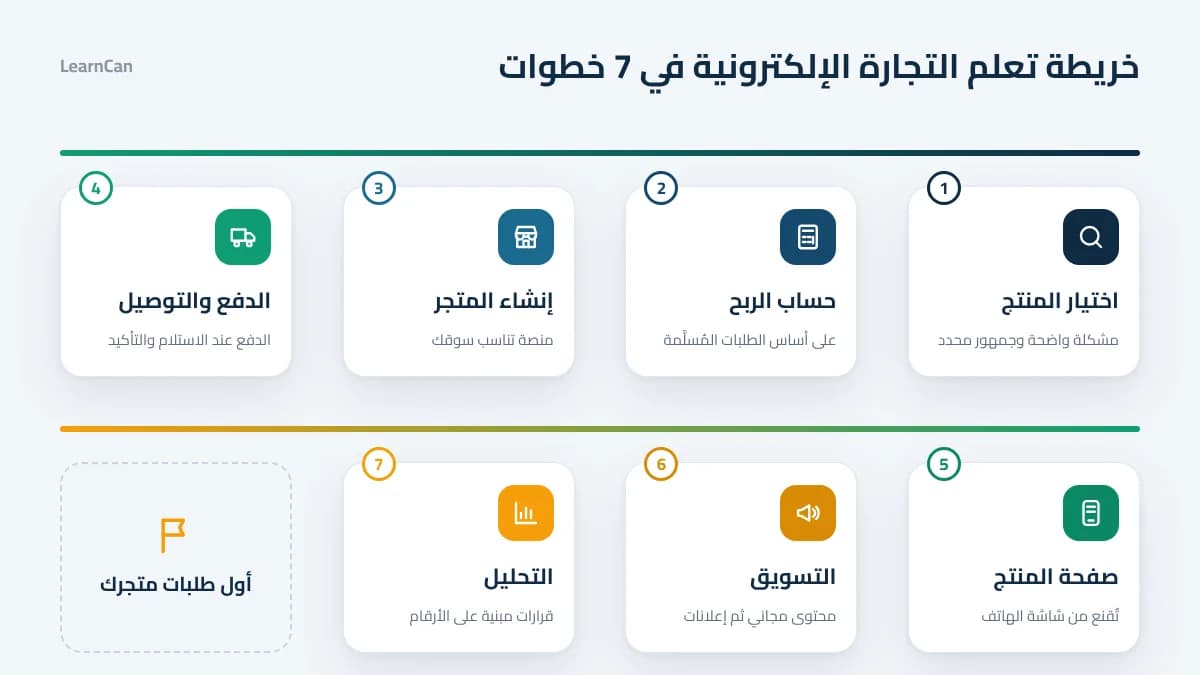
- Choose the product and market: a product that solves a clear problem for a specific audience.
- Work out your profit margin: before spending anything on ads.
- Build the store: pick the right platform for your market.
- Payment and delivery: cash on delivery and order confirmation.
- The product page: the page that convinces visitors to buy.
- Marketing and first orders: free content first, then well-planned ads.
- Analyse and improve: decisions based on numbers, not gut feeling.
Step 1: choose the right product
A winning product is rarely the cheapest; it is the one that solves a problem the customer feels right away. Score every idea against these criteria and drop any product that fails most of them:
- It solves a problem or meets a strong desire: customers get the benefit from one photo or a short video.
- Enough margin: a selling price at least three times the cost.
- Easy to ship: light, unbreakable and rarely returned.
- Not seasonal: wanted all year, not just one month.
- Hard to find in local shops: otherwise, why buy it online?
To check demand before investing, watch search interest on Google Trends, browse your competitors’ ads in the Meta Ad Library and read customer reviews of similar products: recurring complaints are your chance to offer a better product or a better deal.
Step 2: work out your real profit margin
This is where most beginners lose money: they see the gap between buying and selling price and forget every other cost. Here is an example for a product sold at 30 dollars:
Item | Amount (dollars) |
|---|---|
Selling price | 30 |
Product cost | 8 |
Shipping and delivery | 4 |
Ad cost per order | 7 |
Payment and platform fees | 1 |
Net profit per order | 10 |
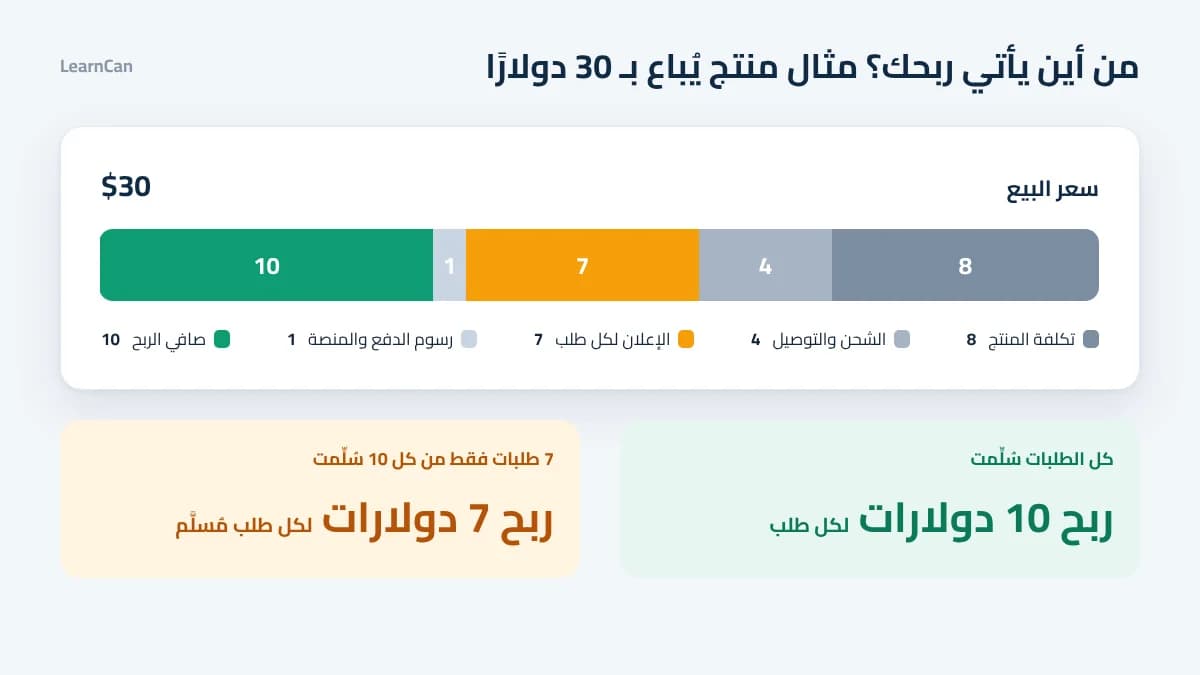
Watch out for a point many people ignore in cash on delivery markets: not every order gets delivered. If customers accept only 7 orders out of 10, the real ad cost per delivered order rises from 7 to 10 dollars and your profit drops from 10 to 7 dollars, before you even count the cost of refused returns. Always calculate on delivered orders, not placed orders.
Step 3: build your online store
You do not need a developer. Choose the platform according to the market you sell in and the payment method your customers prefer:
Platform | What it is | Who is it for? |
|---|---|---|
Shopify | A global hosted platform with a monthly subscription | Sellers targeting international markets who want a ready-made store with many apps |
WooCommerce | A free WordPress plugin; you pay for hosting and the domain | Sellers who want full control and are not afraid of the technical side |
YouCan | A Moroccan platform in Arabic that supports cash on delivery | Sellers in Morocco and Arab markets |
Salla and Zid | Two Saudi platforms in Arabic | Sellers in Saudi Arabia and the Gulf |
Whatever the platform, prepare these before launch: a short domain name, a simple logo, and returns, shipping and contact pages. These pages build trust, and ad platforms require them too.
Step 4: payment, delivery and order confirmation
In many Arab and African markets, cash on delivery is still the customers’ favourite option, because it removes the fear of paying an unknown store in advance. Turn it on, for example by following YouCan’s guide to enabling cash on delivery (page in Arabic). But this option needs a system that protects you from fake orders:
- Confirm every order with a call or a WhatsApp message within hours of it being placed.
- Work with a reliable delivery company that lets you track parcels and know the reason for every refusal.
- Write a clear returns policy: clarity reduces refusals at the door.
- Add card payment later, once customers trust you and your store has a name.
Step 5: a product page that sells
Visitors decide in seconds, usually on a phone screen. Design your product page for mobile first and make sure it has the elements shown in the picture:
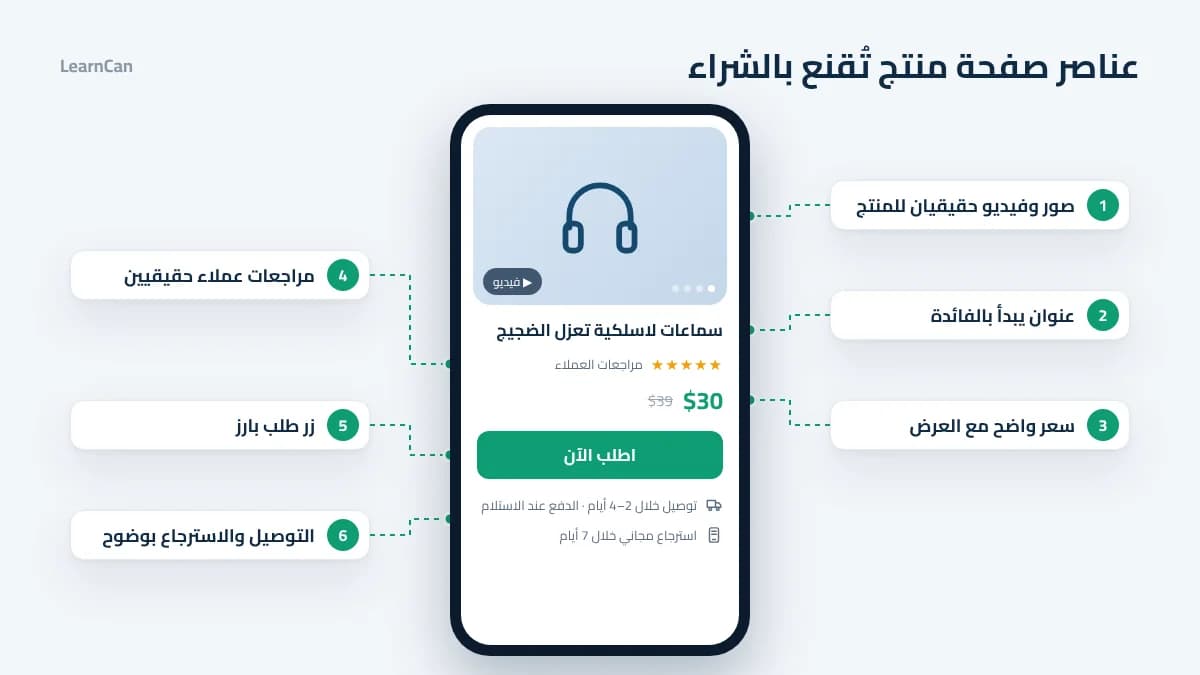
- Real photos and video showing the product in use.
- A title that starts with the benefit, not the technical product name.
- A clear price, with the offer if there is one, and no hidden fees at checkout.
- Genuine customer reviews: never invent reviews; it destroys trust and can get you into legal trouble.
- A prominent order button and a short form that asks only for what is necessary.
- Delivery and returns information close to the order button.
Step 6: marketing and your first orders
Start with free content: short TikTok and Instagram videos that show the problem and then the solution are the cheapest way to test interest. When people engage, move to paid ads with a small test budget, try several photos and videos of the same product, then scale the budget on the ad that brings orders at the lowest cost.
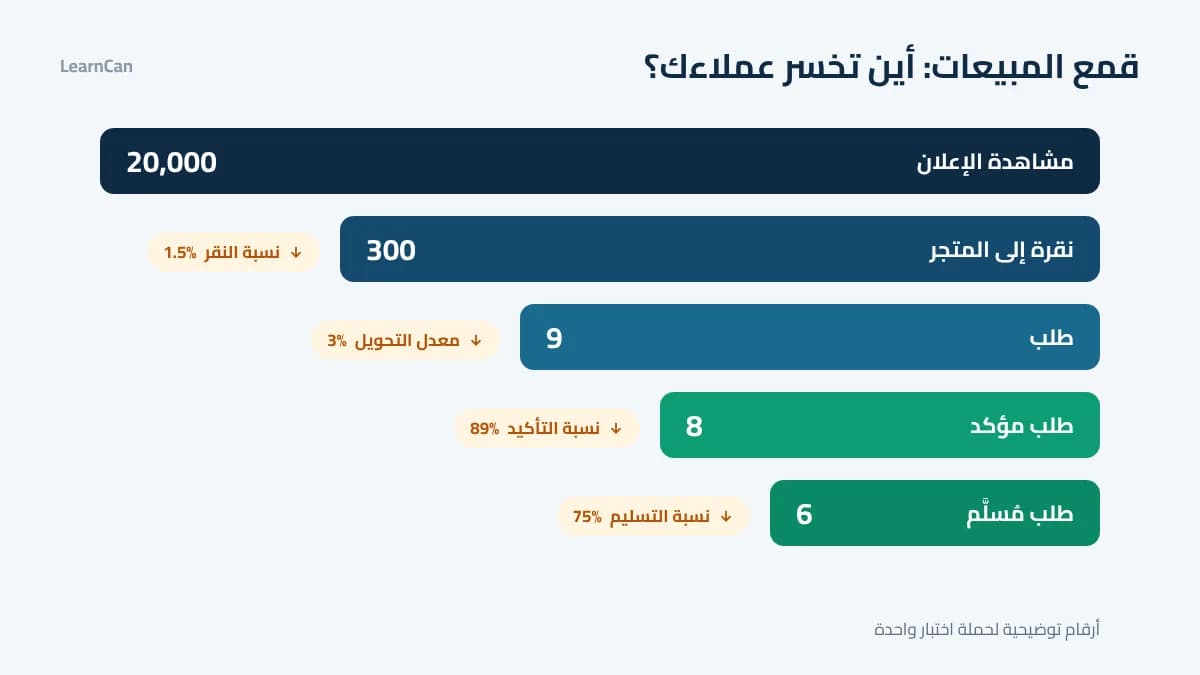
Every campaign goes through this funnel, and each stage has a number to track so you know where you lose customers:
Metric | What it measures |
|---|---|
CTR (click-through rate) | How many people clicked your ad out of those who saw it |
Conversion rate | The share of store visitors who completed an order |
CPA (cost per order) | How much you spent on ads for each order |
Delivery rate | Delivered orders out of confirmed orders |
ROAS (return on ad spend) | Sales generated for each dollar spent on ads |
Step 7: analyse your numbers and improve your store
After two weeks of selling, the numbers tell you what to fix: a weak click-through rate means the ad does not grab attention, weak conversion means the product page does not convince, and a low delivery rate means confirmation or delivery needs work. Change one thing at a time, measure its effect, then move to the next.
Where can you learn e-commerce for free?
You do not need an expensive course to start. These are reliable resources you can learn from without paying anything:
- Shopify Academy: free courses in English on building a store and marketing, listed in the Shopify Academy catalogue.
- Meta Blueprint: free courses on Facebook and Instagram ads; only the official certification exam is paid.
- Platform help centres: step-by-step tutorials for every setting in your store.
- [LearnCan courses](/en/courses): practical content to build your digital skills.
The Google Digital Marketing & E-commerce certificate on Coursera is valuable, but not entirely free: it runs on a monthly subscription, with financial aid available.
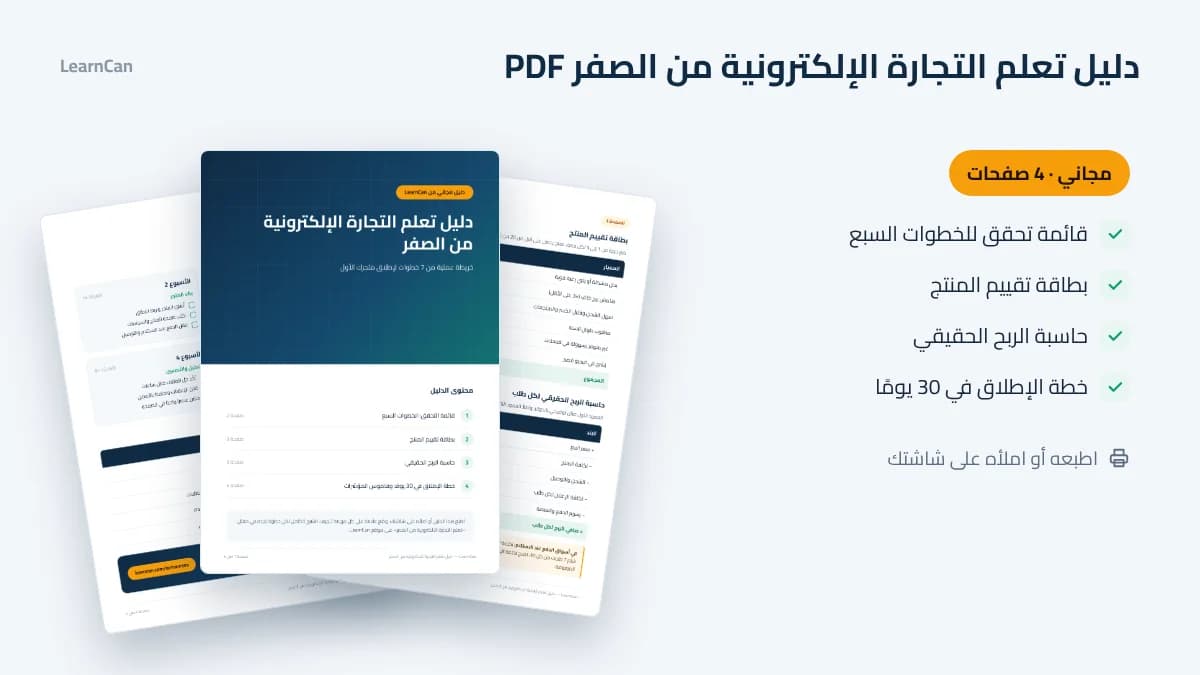
Download the free e-commerce guide (PDF)
We have gathered the essentials of this article in a four-page PDF (in Arabic) to print and fill in: a checklist of the seven steps, a product scoring card, a real-profit table and a 30-day store launch plan. Download the free PDF guide here.
Common beginner mistakes
- Running ads before working out the margin: you find out weeks later that you are selling at a loss.
- Selling everything to everyone: a general store with no clear audience is hard to market.
- Copying competitors’ pages word for word: offer a deal, a guarantee or a service that sets you apart.
- Neglecting customer service: quick replies raise confirmations and reduce refusals.
- Giving up after the first product: most successful sellers tested several products before finding a winner.
Frequently asked questions about e-commerce
How much capital do I need to start?
You can start with a small amount if you choose dropshipping or digital products, but set aside a budget to test ads, which is the biggest cost at the beginning. Start with an amount you can afford to lose, and do not borrow to fund a first attempt.
How long until the first profit?
There is no guaranteed timeline, and anyone promising profits within days is selling a dream. With the 30-day plan you can launch the store and receive your first orders, but reaching a steady profit usually takes several months of testing and improving.
Do I need to register a business?
Rules differ from country to country, and many offer simplified schemes for small businesses and freelancers. Check with the relevant authority in your country before your activity grows: a sound legal status protects you and makes it easier to work with payment and delivery companies.
Summary
To learn e-commerce from scratch, start with one small decision: a single product, an honest profit calculation, a simple store, then steady improvement based on numbers. Download the free guide, start day one of the 30-day plan and, to keep learning, browse the latest articles on LearnCan.